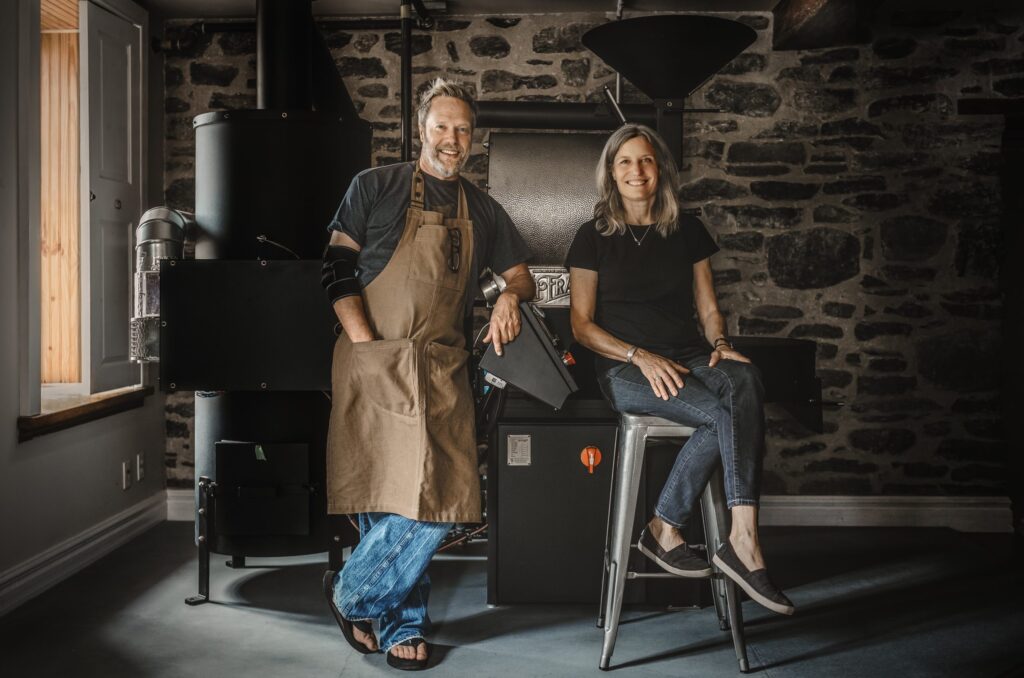
The migratory birds flitting about your backyard feeder this spring might just be there with the help of a coffee roasting company in Vankleek Hill.
Founded in Quebec in 2014, Brûlerie Totem Roasters expanded to the eastern Ontario town in 2019, and like many small coffee companies they source organic coffee from Peru, Honduras, Colombia and Guatemala, as well as Ethiopia.
But it was an avian differentiator that caught my attention: Totem coffee is “Bird Friendly,” a certification of the Smithsonian Institution, so it would seem that we can share a cup of coffee and we our backyard birds.
Birds as indicator species
Our feathered friends are known as an “indicator species:” birds show the effects of pollution, habitat loss, climate and generally act as an early detection system in overall ecosystem health.
As I learned from the Totem team – a small business of only three people – Bird Friendly-certified coffee preserves critical habitat for birds and wildlife and at the same time supports sustainable farmers.
Unfortunately, about 75 per cent of our coffee is farmed without regard for bird populations and forest habitat, according to Smithsonian.
“Deforestation is a huge factor, especially in the coming years with climate change. And so what the Smithsonian has done is to set certain requirements that create viable habitat, not just for birds, but for biodiversity,” says Nancy Kaudel, a co-owner and head coffee roaster at Totem where her brother Bruce Kaudel is director of operations.
Among other conditions, certified coffee plantations must grow 11 tree species with canopies of varying heights as well as implementing agroforestry, which ensures that farmland combines diverse tree varieties and plants with crops or livestock.
“Where it is interesting for us is that many birds that migrate to the coffee plantations actually come here in the summer. So we’re protecting their habitat down south because part of our coffee benefits birding rehab and conservation efforts,” she adds.
An ancillary initiative for Totem is a collaboration with Le Nichoir Wild Bird Conservation Centre, based in Hudson, Qc, called “cafebirdfriendly.org” – sales proceeds of which help fight deforestation, save habitats and wildlife, fairly compensate farmers and support conservation.
I love both birds and coffee so I’m impressed by the range of values at Totem, over and above ecology: while they certainly don’t eschew technology, their roasting is done by hand – the artisanal element – and with less reliance on automation.
While roasting a batch of coffee – which is done on demand once or twice a week – takes only about 15 minutes, there are a number of variables to consider, according to Totem co-owner Carl Dubé.
“We adjust our roasting in real time depending on atmospheric pressure, temperature and humidity levels,” says Dubé who brings a science background to the business. “If it’s a rainy day versus a sunny day, it’s very different. An automated roasting system will run the same way regardless of conditions.”
By the way, if you are interested in grinding your own beans at home, Dubé strongly recommends purchasing a burr grinder which he says is an important first step to better coffee.
Canadians drink a lot of coffee
From fast-food chains to multi-national coffeehouse specialists, there is a wide world of coffee preferences.
According to Statistics Canada, in the month of June last year alone, Canada imported 21 million kilograms of coffee beans. Likely the most popular drink in the country – even above water – Canadians sip about 2.7 cups of coffee each day.
I equate a small roaster like Totem to the local craft beer industry which works diligently amidst global brewing giants. Totem describes themselves as a single-origin roaster sourcing high-quality beans from a single area or single farm.
When you purchase their coffee, the bag is labelled with an origin, the lot number and the roasting date, rather than the best-before date.
“The fact that the products we buy are higher in quality gives a better cup of coffee in the end,” Bruce Kaudel says. “Specialty coffee farmers also get paid a better price for their coffee yield. It’s usually a smaller farm, and they get a good pay for their coffee crop.”
Specialty coffee makes up only about one per cent of coffee worldwide, but when it’s freshly roasted you get a lot more crema and aromas, Dubé notes.
Coffee with a positive impact on the planet
In identifying trends in the coffee sector, Nancy Kaudel says Canada’s west coast has been the biggest driver in the country, though so-called “third-wave” coffee has been moving eastward steadily.
“And globally, the coffee industry now is reaching new markets, the Middle East being one and China another. There’s more demand for specialty coffee, which is one of the factors for the price going up,” she says.
But sadly, the demand has met less production because of climate issues that the birds have indicated – if you are able, it’s a good reason to consider carefully where your coffee dollar goes.
All three of the Totem principals agree that coffee lovers – whether you want to call them aficionados or not – are drawn to the potential of the drink to provide unique and satisfying flavours and a certain camaraderie.
“People love coffee, and there’s definitely an emotional connection to having a cup, either interacting with other people or just your morning cup. It’s a ritual,” says Kaudel.
It seems to me that a business such as Totem provides an opportunity to sip good coffee and to do better for our bird population and the ecosystems and environment on which we all depend. It strikes a balance, according to Dubé.
“One of the things for us is selling people coffee that has a positive impact on the planet, and on peoples’ well-being, whether it be the farmers, the biodiversity that’s in those regions or our biodiversity here. It’s the same birds.”
Food writer Andrew Coppolino lives in Rockland. He is the author of “Farm to Table” and co-author of “Cooking with Shakespeare.” Follow him on Instagram @andrewcoppolino.