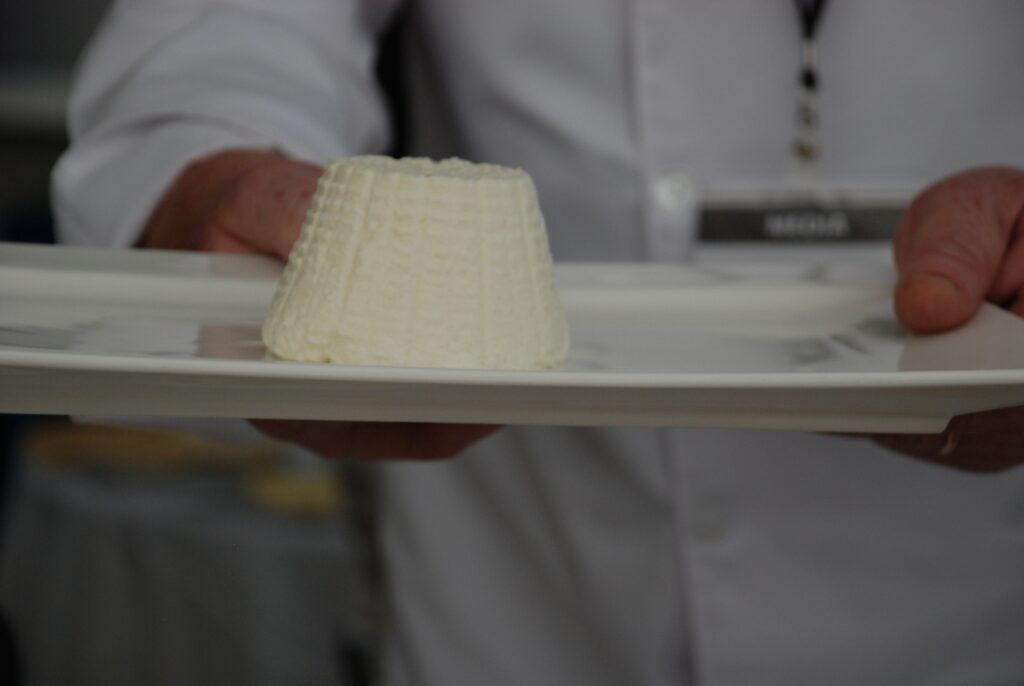
Among the hundreds and hundreds of cheeses made across the globe, ricotta is surely one of the blandest morsels you can find – and I mean that in a very good way.
Why? Because that bland quality is also what makes ricotta an extremely versatile cheese for a wide range of both sweet and savoury dishes. And add to that the fact that you can easily make ricotta at home and its value rises substantially.
Ricotta – from Latin and Italian words meaning “re-cooked” – is what is known as a “whey cheese:” that is, it is a that is cheese made from the liquid (whey) that remains when another cheese has been made from the curds in the cheese-making process. So, in a way, it’s a sort of hand-me-down or leftovers cheese.
Cheese from cheese “leftovers”
Historically, it is likely that enterprising Etruscan cheesemakers from very long ago were trying to find a use for the leftover whey they had on hand after making a larger batch of cheese, possibly a Pecorino hard cheese that was popular wherever there was access to sheep and sheep’s milk: these cheesemakers cooked up the whey a second time and then strained any remaining coagulated curds to make another cheese, which came to be called ricotta, “re-cooked.”
Generally, the older a cheese is, the less moisture it will have. Unlike most other cheeses, ricotta is not aged – it is a fresh cheese, moist, mild and creamy. (An aged, salted version is known as ricotta salata which comes from the Italian island Sardinia, opposite Naples in the Tyrrhenian Sea.)
While Romans may eat ricotta in a savoury fashion, it is the Sicilians – with their unique sweet-tooth character – who cherish it in dessert applications: just think of the tube-shaped fried dough shells which hold together the luscious sweetened ricotta of the famous cannoli.
The ricotta we find in area grocery stores has a rich, creamy texture with just a slight graininess and is finer than cottage cheese (which is coagulated cheese curds and not whey); however, fresh ricotta is also slightly sweeter and much more tasty than the former, especially with a touch of salt.
On occasion, you may find ricotta as an ingredient used in local bakeries such as Chez l’Boulanger, The Black Walnut in Cumberland or the new COBS Bread in Plaza Rockland.
Make your own ricotta at home
However, with a bit of practice, it’s fairly easy to make your own ricotta cheese at home. The only real equipment you need is a thermometer. It may provide a good teaching moment with kids as they explore food science in the kitchen.
Into a large pot, pour 8 cups of whole milk. Add 1/3 of a cup of fresh lemon juice and stir gently for a few minutes to incorporate fully the mixture.
The acid of the lemon juice will cause any milk proteins to clump together. Because you are essentially using the acidity of the lemon and removing water, what is left behind are proteins bound together. Unlike Mozzarella, which melts out on a pizza in the oven, for instance, ricotta (and its cousin chèvre) will basically stay in a solid shape when heated.
Next, place the pot over low heat and bring the liquid to a simmer, about 175-degrees Fahrenheit. Raise the heat to medium and carefully bring the temperature to 205-degrees F. Stay with your pot and pay attention closely to the thermometer. Remove from the heat and let the liquid sit for 10-15 minutes while the curds form.
Remove the curds with a slotted spoon and strain into a bowl through a fine-meshed sieve and cheesecloth or good quality paper towels. Let it drain for about 10 minutes. More or less time draining will produce thinner or thicker ricotta.
Thinner ricotta can be served warm with a few flecks of finishing salt, a drizzle of honey and some fruit. Thicker ricotta can be used for stuffing cannoli or ravioli.
Either way, fresh ricotta can be stored in an air-tight container in the refrigerator for five days.
Food writer Andrew Coppolino lives in Rockland. He is the author of “Farm to Table” and co-author of “Cooking with Shakespeare.” Follow him on Instagram @andrewcoppolino.