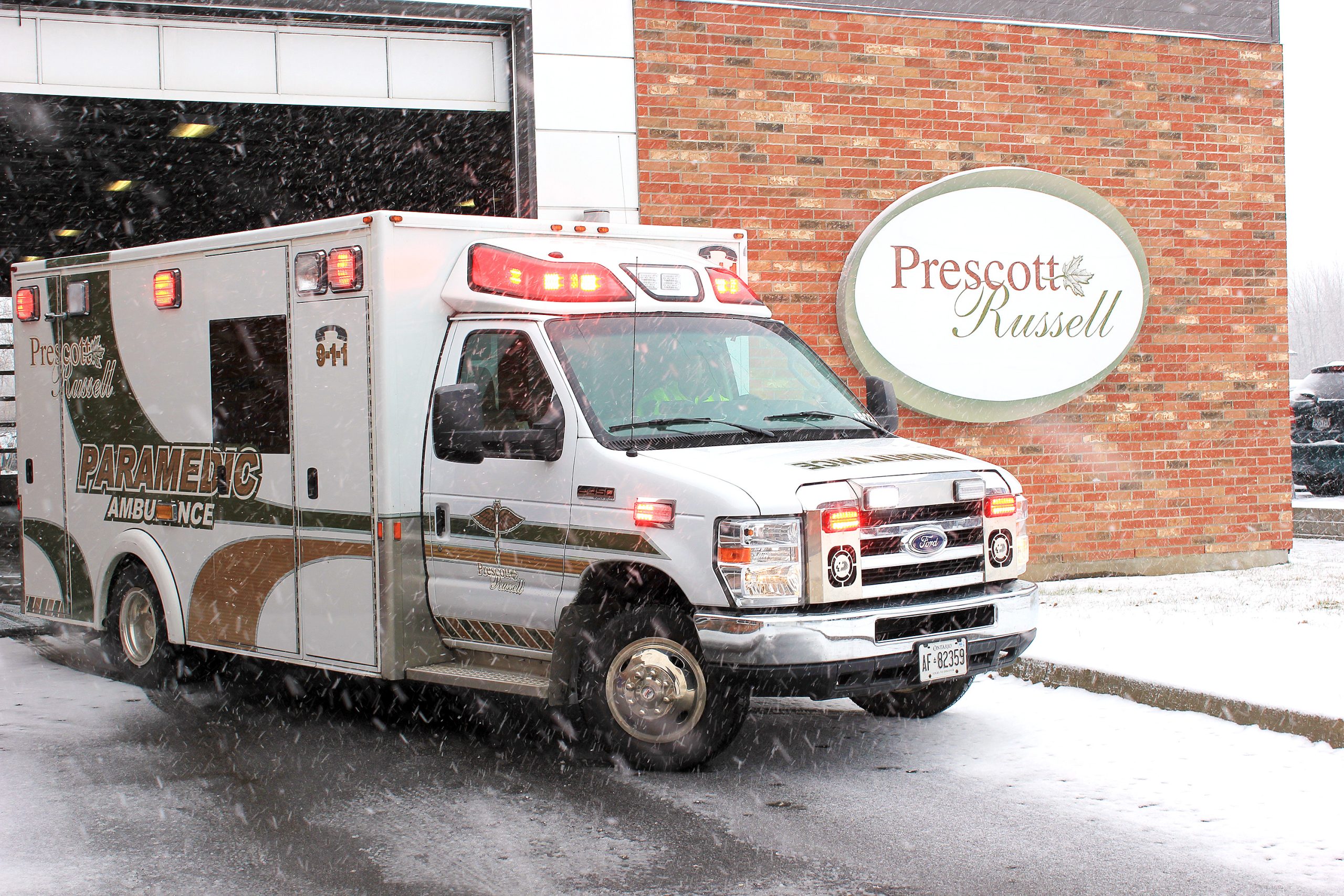
The Prescott and Russell Ambulance Service is seeing some success in its effort to answer emergency calls faster and get patients to hospitals sooner.
Marc-André Périard, director of emergency services for the United Counties of Prescott-Russell (UCPR), presented UCPR council with a summary brief on the the regional ambulance service’s latest annual response times report to the provincial health ministry.
All regional and municipal ambulance services are required to provide the provincial government with regular summary reports on their call-response times.
Périard noted in his report to UCPR council that a new dispatching system was set up for the Eastern Ontario region in April 2024. The focus of the new system was “better prioritization of 911 calls” and to reduce the number of call response demands on neighbouring ambulance services.
Périard stated that the new system “has had a significant impact on the number of calls we are responding to with lights and sirens” and, he added, it has also reduced the number of call demands for Prescott-Russell ambulances from other municipalities. He noted that “is helping us improve our response times.”
Last year the regional ambulance service dealt with a variety of emergency calls, including sudden heart attacks and other incidents related to accidents and other situations.
For calls involving a heart attack that requires use of a defibrillator, the provincial guidelines demand a six-minute response time to answer a call. The ministry target is for at least a 40-per-cent success rate in achieving that response time. Last year the PR Ambulance Service was able to achieve that target 42 per cent of the time, compared to a 38-per-cent achievement rate in 2024.
For a CTAS 1 call, which involves an immediate life-threatening situation for a patient, the provincial guideline demand is an eight-minute response time to answer a call. The ministry target for success is 48 per cent. Last year the PR Ambulance Service achieved a 53-per-cent success rate in response time to that type of call. The 2024 success rate was 43 per cent.
The 2025 response time report shows similar success in either exceeding or almost achieving ministry success targets for other categories of emergency ambulance calls.