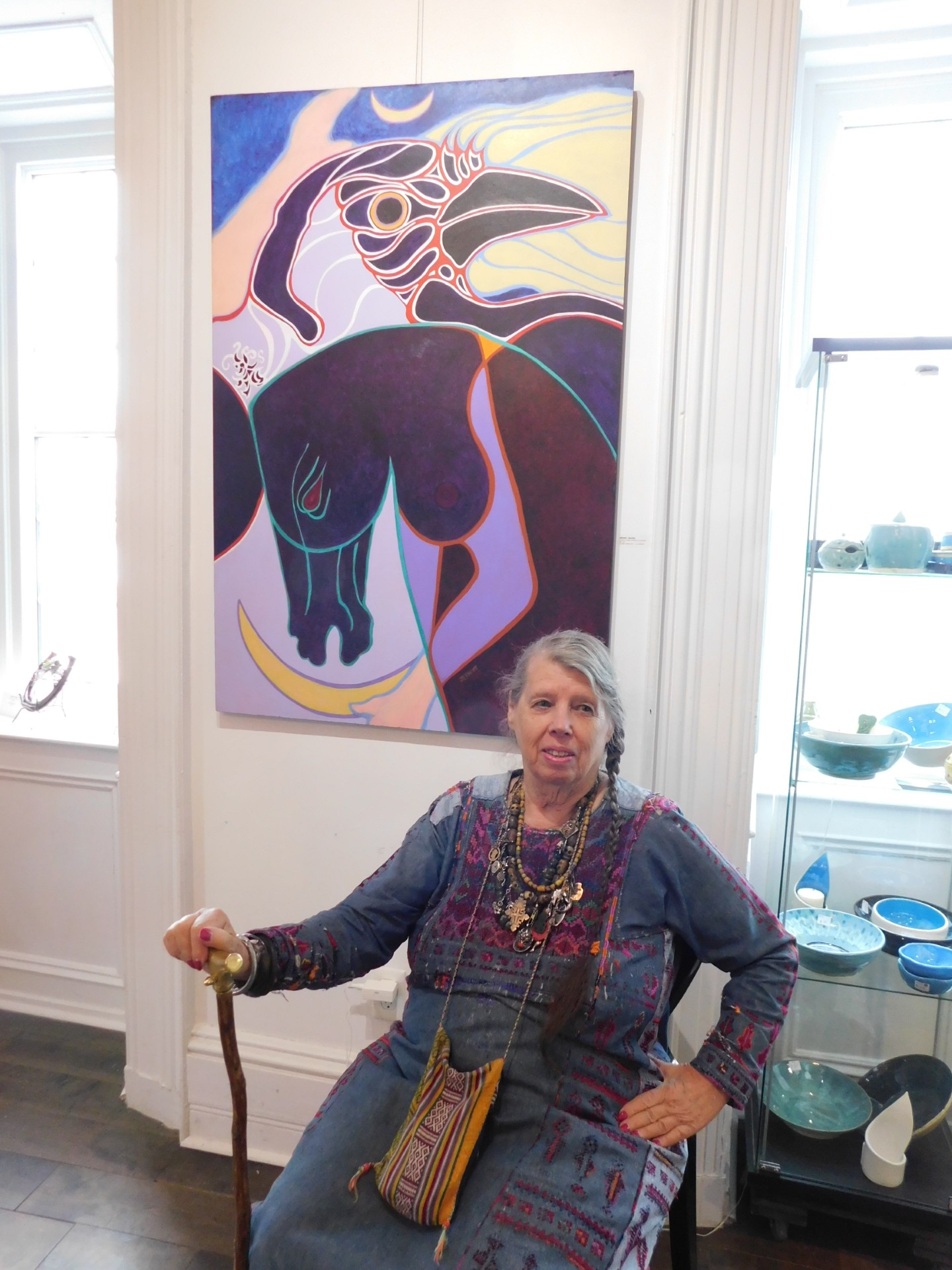
If horses could dream, they might dream of being unicorns, and that would be a wonderful thing to see for Susan Jephcott.
“I love the unicorn,” said Jephcott. “It’s on my family crest.”
The Vankleek Hill artist is a member of the Seward of Appin clan, one of the Highland clans of Scotland. The family crest features a fierce-looking unicorn’s head, encircled by a buckled swordbelt, with the motto, “Quhidder Wil Wie” or “Whither will ye”, above the unicorn head.
In heraldy, a unicorn is symbolic of freedom from the bonds of slavery and servitude. Jephcott has her own multi-faceted interpretation of what a unicorn symbolizes.
“For me, it’s a symbol of courage, beauty, kindness, ferocity, and behaving in the right way,” she said.
A very young artist
Jephcott is one of the artists featured in the current “Chevaux de coeur Heart Horses” exhibition that debuted at Le Chenail Cultural Centre April 1. Participating artists offered up a wide range of their interpretations for the equine theme, with Jephcott’s series of unicorn art providing an air of wonder to the exhibit.
The unicorn is just one of many subjects for Jephcott’s artistic endeavours, which began at a very young age.
“I’ve been drawing and painting since I was three years old,” the 87-year-old artist said, smiling and eyes twinkling. “I’m still waiting to grow up.”
Jephcott recalled that part of her early childhood was spent crawling under some of the household furniture and drawing various illustrations on the wooden underside. At that time she worked in crayon like all children do but later on she inherited a watercolour paint set that had once belonged to her grandfather, who was himself an artist. Later, when she was about 11 or 12, her grandmother gifted her with oil paints, which became her childhood favourite medium for her artistic ideas and visions.
“I decided that I liked oil because it was like real painting,” she said.
Horses were a favourite subject for the young artist at that time, along with a variety of attempts at portraits of wild animal seen out and about where she lived.
“I tried painting deer but I found the antlers difficult,” she said. “But I loved painting horses.”
While still in school, Jephcott knew that art would be both her passion and her life’s work.
“I guess I’ve always decided that I would be an artist,” she said.
Jephcott attended art school early on and also night school. But circumstances dictated she needed to find steady employment while continuing to pursue her artist’s dreams. She worked for Sun Life Insurance in Montréal, then left after a time to spend two years down in Jamaica, returning home and continuing her artistic pursuits.
“I work in acrylics now,” she said, “and I continue to use pen-and-ink. I like the detail work possible.
Save the world
Like many artists, Jephcott is intrigued by the possibilities of working with unique or unusual substitutes for a standard canvas. She began recycling old piano keys as part of a fundraiser project using her art to promote public awareness of the
plights of elephants in Africa and India, whose tusks were once harvested, most often at the cost of their lives, for the manufacture of piano keys. Nowadays ivory is no longer used for piano keys but elephants are in danger of becoming victims to poachers seeking to profit from black market sales of ivory tusks.
Jephcott’s piano key miniatures, featuring illustrations alternating between whimsical and serious, raised about $1000 for the World Wildlife Fund. Her elephantine piano key miniatures are just one of several animal-related special projects that captured her interest over the years, including several honouring the Chinese zodiac.
“I’ve also done horses for the Year of the Horse, snakes for the Year of the Snake, and tigers for the Year of the Tiger,” she said.
What inspires Jephcott these days is what will become of the world depending on the actions of humankind.
“It’s the future of the world and of the planet,” she said. “I feel angry about that, and I feel the need to wake people up.”
One of her projects, “Walls”, is a series of paintings focused on the theme of immigration policies in Canada and the United States. Within the variety of walls featured in the paintings is a notorious symbol that expresses Jephcott’s concern.
“Hidden in the wall of each painting is a swastika,” she said.
The crooked cross, as it is sometimes called, is a symbol of spirituality in many Eastern religions, but it now more notorious as the symbol of Nazism and that is the point that Jephcott makes in her “Walls” series about the rising of political and social barriers to immigration and immigrants.
“No matter how good it may look,” she said, “it’s not good to divide people.”
When not working on her various art projects, Jephcott relaxes with an ecletic reading list that ranges from The Wind in the Willows to Agatha Christie mysteries.
“I read her (Agatha Christie) in French to help improve my French,” said Jephcott, smiling.
Her advice to anyone interested in art is always be prepared for inspiration.
“I always carry carry a pen or pencil and my sketch book,” she said. “You can never draw too much. If you find out you’re an artist, you have to be an artist.”