Most everyone would agree that the Internet seems to enjoy sending us a steady stream of information about a wide variety of topics.
Whether we are asking for it or not, an immense load of facts and information – which may or may not be accurate – appears endlessly on our phones each and every day, from a famous birthday to whether the moon is waxing or waning.
That also includes certain special “days” that signify a notable event, person or condition: Marie Curie’s birthday, National Brain Day, or International Dolphin Week.
And arbitrary or not, whatever organizations decree that these kinds of honorifics and recognitions do in fact exist, they have seen fit to announce that there is not just one but two “National Crème Brûlée” days, July 21 and July 27.
I’m not sure which day, if either, has any sort of historical grounding outside of one marketing scheme or another, but I do see the dual designation as a clear indication of how popular the classic dessert actually is.
Given that fact, I’d say the creamy-smooth laurels bequeathed on crème brûlée are indeed well-deserved.
A dessert centuries in the making
With its presence on restaurant menus across a broad spectrum, it is probably true that at one time or another every chef has made a crème brûlée and many restaurants include it among its desserts; spend a few moments scanning menus just at random, and I’m sure you will find several.
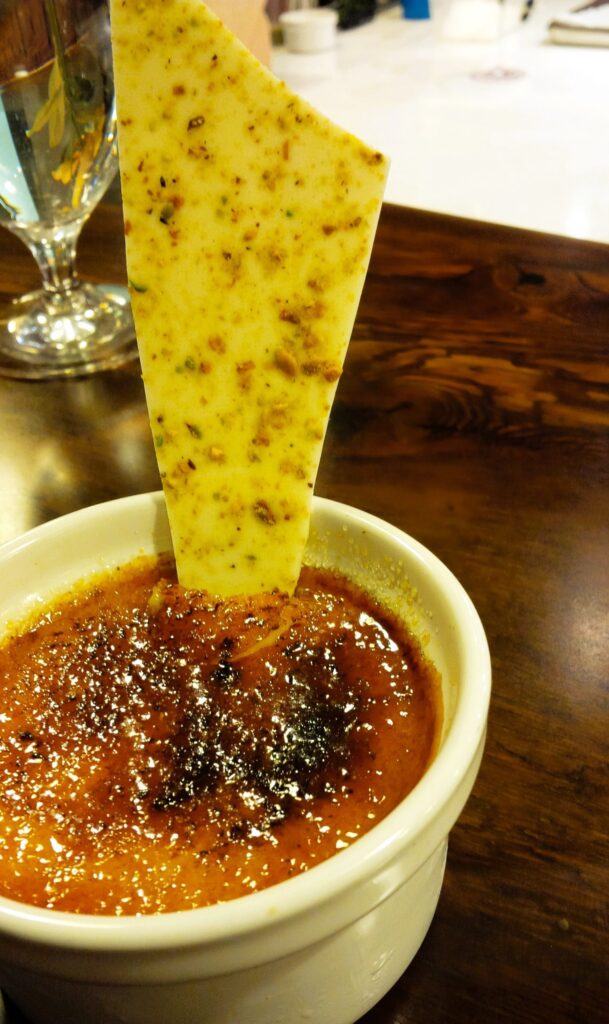
Literally “burned cream,” crème brûlée is a custard – an egg-milk combination – that is one of our oldest culinary concoctions, and they can be either soft or firm in their texture.
The word custard derives from the French “croustade” which in the Middle Ages referred to any foodstuff that was served in a crust. And, accordingly, a proper crème brûlée, therefore, has a soft, creamy and rich interior covered by a crisp crust of caramelized sugar.
Merely saying it is a popular dessert hardly does the dish justice: there are crème brûlée recipes attributed to Francois Massialot, chef to the dukes of Chartres and Orléans, dating to the French court of 1692. His is the first recorded crème brûlée recipe making it more than 300 years we have been preparing the luscious treat.
(Massialot, by the way, is also likely one of the first cookbook authors to list recipes in alphabetical order – and to also include dishes suited to the “middle class,” and not merely aristocracy. That much is obvious in the title of his 1692 book “Le Cuisinier roial et bourgeois.”)
Cool, soft interior with a crisp crust on top
A custard of scalded milk or cream, sugar and egg yolks, crème brûlée requires cooking the mixture in a bain-marie water bath to a soft, silken texture that creates a cohesive “ribbon” as it runs off your spoon.
The mixture is what is essentially a crème anglaise that might be used for an ice cream base before it is baked in the water bath.
The baked custard is then chilled before adding a fine layer of sugar to the top and caramelizing it, either under a hot broiler (in a restaurant kitchen, what is known as the “salamander”) or the fun way with a propane or butane torch before being served to an eagerly anticipating customer.
In Massialot’s recipe, he writes, “remove (the custard) from the heat, and sugar it well; take the fire iron good and red, and burn the cream so that it takes on a fine gold colour.” (Incidentally, the “fire iron” may replicate the curvy shape of a mythical Medieval creature, like a salamander, who was said to be able to withstand fire and extreme heat.)
The key to a good crème brûlée is to keep a cool, silky custard interior while getting just the right crispness – and not a rock-solid layer of impenetrable sugar – on the top: the result is a well-balanced crunch and a bit of “shatter” when you plunge in your spoon.
A Rockland favourite
Few area restaurants serve the dish. At Brauwerk Hoffman, it is currently off the menu, though brewmaster and co-owner Eric Mainville says that it could possibly make a return to their taproom in the future.
But Alana Paolini, co-owner of Rosalynn’s Bistro, on Laporte Street, says crème brûlée has been on their menu for the last 15 years, calling it “by far” their most popular dessert and one which, she says, has even garnered praise from a pair of her Rockland customers when they travelled to France.
“They ordered a crème brûlée and sent me a picture from the restaurant. They said that chef Peter’s here at Rosalynn’s was far better. And this was a place in France that was well known for it,” she says, calling the comment quite the compliment.
Rosalynn’s changes their crème brûlée frequently, Paolini adds. That could be Bailey’s, Amaretto, chocolate, pumpkin or eggnog.
“It depends on the season,” she says.
Clearly, that is another reason for the dual-day designation that the dessert gets in July: aside from its deliciousness, crème brûlée is versatile, a custard that’s a blank slate that scrumptiously welcomes a vast array of sweet and savoury ingredients.
Food writer Andrew Coppolino lives in Rockland. He is the author of “Farm to Table” and co-author of “Cooking with Shakespeare.” Follow him on Instagram @andrewcoppolino.