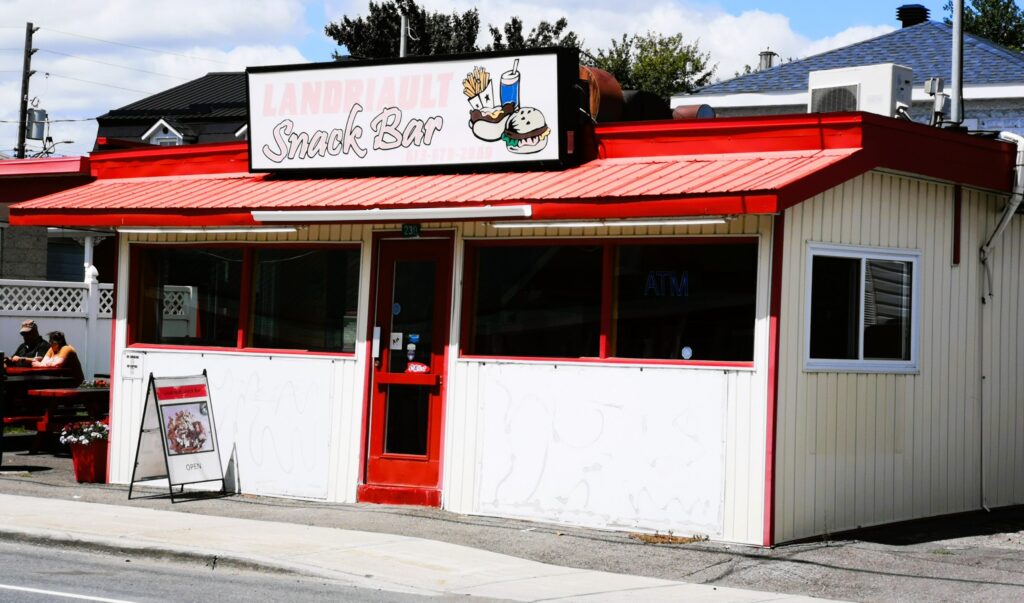
Travel east on County Road 17, which becomes St. Philippe Street, and you’ll drive past the big “ALFRED” sign that’s similar to the Ottawa version in ByWard Market. Less obvious as you then pass Quesnel Street is Landriault Snack Bar even though the small food operation has been there much, much longer than the five upper case blue letters.
A classic casse-croûte or pataterie, the historical specifics of the small snack stand may have been lost to the passage of time, but its popularity as a spot to grab a poutine or an all-dressed steamie has not.
In fact, Landriault Snack Bar continues to draw both hungry local customers and those from further afield as it has done for at least six decades. That’s correct: about 60 years. And likely more than that if you did some serious historical digging.
A small-town roadside stand with little-known history and good fries
The name Landriault pops up on few business signs in locations I’ve spotted along the highway in the neighbouring area. One early record of the name is a “T. Landriault,” born in 1821 in Prescott County. “T” eventually became a farmer and town councillor, according to McGill University’s “Canadian County Atlas Digital Project.”
The snack bar, currently owned by Bruce Forget, stands on the site of what was once someone’s home before it burned down ages ago. The story goes that it was replaced by the small take-away food stand which today has a covered patio and a half-dozen or so picnic tables. Apparently, next door was once a jewellery store, now long gone.
According to Landriault Snack Bar general manager Fiona Massie, the stand’s most popular menu item are the various sizes of the French fries. That’s not surprising: it’s much of what a casse-croûte is all about – and I’ve come to learn since I’ve moved here that very good fries are made in eastern Ontario.
“We use red potatoes that are delivered every week from a nearby Quebec farm. We cut and peel them ourselves every morning before the day starts. They’re done by hand and there’s no freezing involved,” says Massie.
At either a casual upscale bistro or a chip truck, the only way to make very good French fries is to cook them at least twice: that usually starts with a cook at a lower temperature to blanch the fries before giving them a final cook at a higher temperature for service.
Landriault blanches their fries, cools them and then finishes them when the order comes into the kitchen.
“There are always fresh fries going out the door,” Massie says. “And we use peanut oil. As far as I’m aware, this snack bar has been using peanut oil at least for the last three owners. The peanut oil offers a different taste and twist to the potatoes, and it’s one reason our fries are so popular.”
While each service is different, the snack bar sends out about 25 hotdog-and-fry combos during an average lunch, in addition to individual items and other combos.
From poutines and club sandwiches to “Michigan” dogs
For Landriault’s popular poutine varieties, the fries form the all-important base to which is added the ubiquitous St. Albert cheese curds and a homemade chicken-based gravy.
The menu includes the round-up of usual snack–bar suspects: whistle dogs, smoked meat, onion rings, sausage, chicken nuggets, pogos, BLTs, cheese sticks, milk shakes and more.
Observing customers munching at the picnic tables on a couple of visits this summer, it’s safe to say that the club sandwiches – something of a snack–bar anomaly, perhaps – are also a very popular customer choice, a fact confirmed by Massie.
Otherwise, what caught my eye first at Landriault was something called a “Michigan dog.” Perhaps related to the Coney Island chili dog, the history of the Michigan dog (sometimes with a small-em as in “michigan”) is unclear. What is understood is that the Coney-style dog is apparently very popular in Detroit, Michigan.
The Michigan dog was possibly created by some ex-pat Michiganders who opened a snack bar in Lake Champlain, New York, in the 1920s: the dog is traditionally a steamed all-beef wiener swaddled in a tomato-forward sauce that is then traditionally topped with onions and yellow ballpark mustard.
“We offer it toasted or steamed,” Massie says of the Landriault rendition, though adding that tracing its origins at the snack bar is likely impossible. “The sauce is our Italian kind-of-like-spaghetti sauce that we make here, so it’s homemade as well. It’s not quite a chili dog, but a similar style. You can add extra onions, and some people like to add cheese.”
In the pantheon of handheld snacks that are out there, the drippy-juicy dog when it is passed over the counter to you might be considered one that once you pick it up to eat you don’t set it down again with a whole lot of mess. Landriault also serves a Michigan burger, similarly dressed.
“People generally eat it with a fork and knife,” Massie adds.
Dishing out continuity and community
In itself, an item like the inscrutable Michigan dog captures at least a portion of the lost elements of Landriault Snack Bar’s history. Massie says that many of the menu items have been passed down from owner to owner over the decades which establishes a sense of continuity, as well as a sense of local community, even if the details are murky.
“We’ve maintained the same menu,” she says despite changing eras. “These are known items, and we’ve just continued selling them rather than reinvent the wheel.”
Certainly a part of the culinary fabric you can find along the highways and byways of Quebec, the casse-croûte is also firmly ensconced in Franco-Ontario food culture with its relatively uniform range of snacks complemented by a unique dish or two.
While the precise history of a venue like Landriault Snack Bar may now be lost, the unassuming landmark venue serves up a long tradition as well as favourite local foods.
Food writer Andrew Coppolino lives in Rockland. He is the author of “Farm to Table” and co-author of “Cooking with Shakespeare.” Follow him on Instagram @andrewcoppolino.